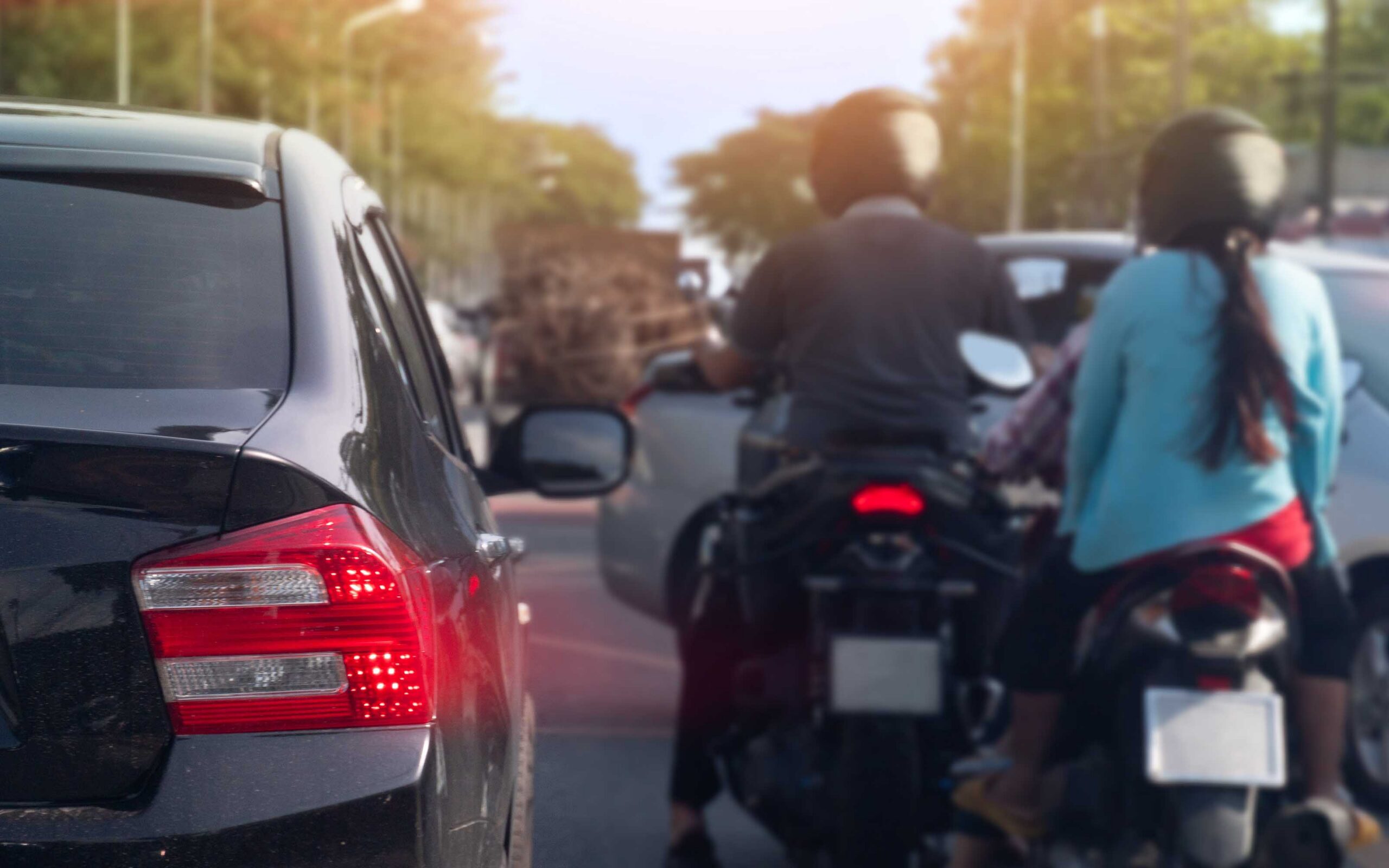
Yes. Lane filtering in Arizona is legal under specific conditions in A.R.S. § 28-903. A rider on a two-wheeled motorcycle may pass stopped vehicles between lanes on a street with at least two lanes in the same direction and a speed limit of 45 mph or less. The rider must stay at or under 15 mph and filter only when it’s safe.
The law took effect in September 2022. For Tucson riders, it comes up most at red lights on busy streets like Broadway Boulevard, Grant Road, and Oracle Road. Filtering legally doesn’t settle who’s at fault if a crash happens, though. Grabb & Durando handles motorcycle accident claims in Tucson, and fault questions around filtering come up often, so it helps to understand both the rules and how Arizona divides fault.
What Is the Difference Between Lane Filtering and Lane Splitting in Arizona?
The difference is whether traffic is stopped or moving.
Lane filtering means riding between lanes past vehicles that are stopped, such as cars waiting at a red light. Arizona allows this when every condition in A.R.S. § 28-903(F) is met.
Lane splitting means riding between lanes of moving traffic. Arizona generally prohibits this practice under A.R.S. § 28-903(C), except when the specific lane-filtering requirements are met. Effective September 12, 2026, illegal lane splitting can also be classified as reckless driving under HB 2941, a Class 2 misdemeanor.
So a rider coming up on stopped traffic at a red light on Grant Road may be able to filter if the street qualifies. A rider weaving between cars that are still moving down the road is outside the exception.
What Are the Rules for Lane Filtering in Arizona?
Under A.R.S. § 28-903(F), all of these conditions must be met:
- Two-wheeled motorcycle: The exception applies to two-wheeled motorcycles, not trikes or other vehicles.
- Stopped traffic: The vehicle being passed must be stopped and headed the same direction, in the same lane as the rider.
- At least two lanes in the same direction: The street must have two or more adjacent lanes going the same way.
- Speed limit of 45 mph or less: The posted limit on the street can’t be higher than 45 mph.
- Rider speed of 15 mph or less: The motorcycle can’t go faster than 15 mph while filtering.
- Safe to do: Even when everything else lines up, the move has to be one that can be made safely.
You can read the full text of A.R.S. § 28-903 on the Arizona State Legislature website.
Can You Lane Filter at a Red Light in Tucson?
Yes, if the street qualifies and traffic is stopped. A red light by itself doesn’t make filtering legal.
On a stretch of Broadway Boulevard with two lanes in your direction and a posted limit of 45 mph or less, you could pass stopped cars at no more than 15 mph. Once traffic starts moving, the exception no longer applies. It also doesn’t apply on segments posted above 45 mph, which includes some higher-speed stretches around town.
Why Does Lane Filtering in Arizona Matter for Tucson Riders?
Tucson riders are out year round, and summer heat makes sitting in stopped traffic on a motorcycle miserable. Filtering lets a rider move up instead of idling between hot cars.
It still takes judgment. Near intersections, driveways, and turn lanes, traffic can change fast. Drivers often don’t expect a motorcycle between lanes, and someone may change lanes, swing into a turn, or open a door without looking. If there isn’t enough room or the path isn’t clear, staying in line is the better call.
How Do Insurers Argue Fault After a Lane Filtering Crash?
After a crash, an insurance company will look at whether the rider followed A.R.S. § 28-903 and whether the other driver was careless. Legal filtering doesn’t automatically mean the rider had no fault.
An insurer may argue that the rider:
- Went faster than 15 mph
- Filtered on a street posted above 45 mph
- Passed vehicles that were moving, not stopped
- Squeezed through a gap that wasn’t wide enough to pass safely
The other driver’s conduct gets examined too. A driver who changes lanes or turns without checking for a motorcycle may share the blame or carry most of it.
What Evidence Helps Show What Happened?
Evidence often decides the questions that matter most, like whether traffic was stopped and how fast the motorcycle was going. Helpful evidence includes:
- Dashcam, helmet cam, or nearby business video
- Photos of the road, lane markings, signals, and where each vehicle ended up
- Witness names and statements
- The police report
- Damage to the motorcycle and the other vehicle
The posted speed limit and whether surrounding traffic was moving tie directly to the statute, so document them if you can.
How Does Comparative Fault Work After a Motorcycle Crash in Arizona?
Arizona uses pure comparative fault under A.R.S. § 12-2505. If a rider’s own negligence contributed to a crash, the rider’s damages are generally reduced by their percentage of fault. A rider can still bring a claim even if they were partly responsible.
For example, if a rider is found 20% at fault and the other driver 80% at fault, the rider’s damages would generally be reduced by 20%. The final split depends on the evidence. An insurance adjuster’s early estimate isn’t the last word.
We cover this in more detail in our post on filing a personal injury claim when you were partially at fault.
Can You Bring a Claim If You Were Lane Filtering in Arizona?
Possibly. A rider who was filtering may still have a claim if another driver’s negligence caused or contributed to the crash. A few questions shape that claim:
- Was the filtering lawful? Speed, the posted limit, traffic conditions, and safety all matter.
- Was the other driver careless? An unsafe turn or lane change can make a driver responsible.
- Did the rider contribute? Any rider fault may reduce damages under comparative fault rules.
- What are the losses? Medical bills, lost income, and other documented losses are part of the evaluation.
Filtering doesn’t erase a rider’s right to bring a claim. Following the statute doesn’t prove the other driver was at fault, either. Every crash needs its own look at the facts.
What Should You Do After a Lane Filtering Motorcycle Crash in Tucson?
These steps protect your health and the evidence:
- Get medical care. Get checked promptly, even if you feel fine at first.
- Document the scene. If it’s safe, photograph the road, vehicle positions, signals, lane markings, and damage.
- Get witness information. Collect names and phone numbers from anyone who saw the crash.
- Save video. Keep your own footage and note nearby cameras before the recordings are overwritten.
- Keep your records. Hold on to medical bills, repair estimates, and proof of missed work.
- Stick to the facts. Give accurate information, but don’t guess about fault before the facts are clear.
Our guide on what to do immediately after a car accident in Arizona walks through these steps in more detail, and most of it applies to motorcycle crashes too.
How Can a Tucson Motorcycle Accident Lawyer Help After a Lane Filtering Crash?
A Tucson motorcycle accident lawyer can look at whether the filtering met A.R.S. § 28-903, review what the other driver did, and explain how comparative fault may affect the claim.
If an insurer says the rider was going too fast between stopped cars, video and witness accounts can clarify what traffic was doing and how the motorcycle was moving. A lawyer can also gather medical records and other documents that support the claimed losses.
Frequently Asked Questions
Is lane filtering legal in Arizona in 2026?
Yes. Lane filtering in Arizona remains legal under A.R.S. § 28-903(F) when every condition is met: a two-wheeled motorcycle, stopped traffic, two or more lanes in the same direction, a posted limit of 45 mph or less, and a rider speed of 15 mph or less.
Can motorcycles lane split on Arizona freeways?
No. Arizona generally prohibits lane splitting between moving vehicles. Under HB 2941, effective September 12, 2026, motorcycle operators who violate the restrictions under A.R.S. § 28-903(B) or (C) may be charged with reckless driving, a Class 2 misdemeanor. Legal lane filtering remains permitted when all statutory conditions are met.
Can you lane filter on a trike in Arizona?
No. A.R.S. § 28-903(F) specifically permits lane filtering by operators of two-wheeled motorcycles. Trikes do not qualify for this exception.
What is the maximum speed for lane filtering in Arizona?
15 mph. The street itself must also have a posted speed limit of 45 mph or less.
Talk With a Tucson Motorcycle Accident Lawyer
Grabb & Durando has been serving Tucson since 1994. If you have questions after a lane filtering crash or a dispute over fault, call (520) 222-2222, available 24/7, or request a free consultation online. There are no fees unless we win, and Sí, Hablamos Español.
This post is for general information and isn’t legal advice.